“I constantly hold that there is a Purgatory, and that the souls therein detained are helped by the suffrages of the faithful.”1
According to the Catechism of the Catholic Church, paragraph 1030, “All who die in Gods grace and friendship, but still imperfectly purified, are indeed assured of their eternal salvation, but after death they undergo purification, so as to achieve the holiness necessary to enter the joy of heaven.”
The Second Vatican Council, p. 63, says, “The truth has been divinely revealed that sins are followed by punishments. God’s holiness and justice inflict them. Sins must be expiated. This may be done on this earth through the sorrows, miseries, and trials of this life and, above all, through death. Otherwise, the expiation must be made in the next life through fire and torments or purifying punishments.”
This process of purification occurs in a place designated by the Catholic church as purgatory. According to Catholic doctrine, purgatory is not supposed to be a place of punishment but of purification. The nature of this purification, according to different Catholic theologians, ranges from an extreme awareness of loss to an intense, excruciatingly painful “purifying fire.”
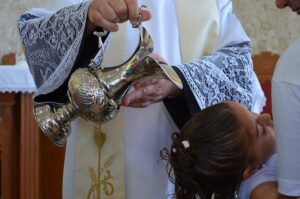
According to Roman Catholic Doctrine, though a person may be in a state of grace, he may not enter heaven until he is purified from sins that were not dealt with on earth. Baptism remits sins committed up to that point; but prayers, indulgences, penance, absolution, and the Mass are means by which the sinner is able to expiate sins committed after baptism. If sins are not remitted, after death he must suffer the flames of purification until he is sufficiently cleansed and pure so as to enter into the presence of God. Additionally, intercession can be made by Catholics on behalf of those who are presently in purgatory. This is also done through saying the Mass, certain acts of penance, saying the Rosary, or by indulgences where the benefit is applied to the dead in purgatory.
But purgatory is not for everyone. Baptized infants who have died before the age of accountability and Catholic saints who lived such holy lives are excused from the “purifying fires.”
The length of time that someone must suffer in this state is never known, but it is considered to be proportional to the nature and severity of the sins committed. Therefore, it could be anywhere from a few hours to millions of years.
Problems with the Doctrine of Purgatory
As a Christian who bases spiritual truth on the Bible alone, I see problems with the doctrine of purgatory. For example:
- It is not explicitly found in the Bible.
- It implies that the righteousness of Christ does not cleanse from all sin.
- It implies that justification is not by faith alone.
- It implies that there is something we must do in order to be cleansed of sin.
The Catholics will disagree with my perceived problems of the doctrine of purgatory. That is to be expected. They will cite church Fathers, the Apocrypha, and various biblical references to fire and purification. Whichever side of the argument you fall into, my goal here is to present a biblical argument that examines the doctrine in an attempt to determine if it is biblical or not.
Of course, the Catholic will say that as a Protestant, I come to the argument with the preconceived belief that (1) Purgatory is unbiblical, (2) that I am biased against it, and (3) that I have an agenda to accomplish. To each of these accusations, I admit guilt. None of us are perfectly unbiased, and most everyone has personal beliefs that are reflected in their actions and words. In this case, having read and studied the Bible thoroughly, I find no place in it for the Roman Catholic doctrine of Purgatory.
References
| 1↑ | The Trentine Creed, of Pius IV, A.D. 1564, found in Roberts, A., J. Donaldson, and A. C. Coxe, The Ante-Nicene Fathers Vol. VIII: Translations of the Writings of the Fathers Down to A.D. 325, 1997, p. 643. |
|---|