The Qur'an

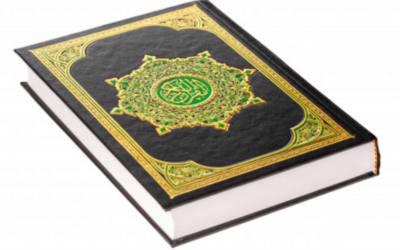
The Qur'an (Koran, Quran) is the Holy Book of Islam and the religion's most sacred writing. Muslims consider it the actual word of Allah and not the word of Muhammad to whom it was given. Muslim tradition states that the angel Gabriel visited Muhammad and gave him the words directly from Allah. These words were Allah's words of wisdom, truth, and commandments to His creation. The Qur'an (which means recitation) was revealed in the Arabic dialect used by the Quraish tribe of Mecca of that time. This dialect became the formal Arabic of the Islamic nations due to the distribution of Qur'anic scriptures throughout the Islamic empire. In the Arabic the Qur'an is poetic in style with rhymes, meter, and shifts in line lengths. Those who speak the language say it is a beautiful work.
The Qur'an deals mainly with what and how Allah wants mankind to believe and do in Man's moral struggle. Its primary theme is that of complete submission to the will of Allah. However, it also teaches...
- there is only one sovereign God (3:191; 5:73; 112:1-4).
- there will be an end of the world and judgment day (:30; 35:33-37).
- those who are not Muslims will go to hell (2:24; 3:12).
- that those whose good deeds exceed their bad will obtain paradise (3:135; 7:8-9; 21:47).
- social and ethical behavior for Islamic society.
In the year 610 (believed to be the 26th of Ramadan), while in a cave on Mt. Hirah, which is now called Mount Jabal Nur, Muhammad said that the angel Gabriel appeared to him and commanded him to recite (96:1-19). From that point on, Muhammad claimed to have received revelations up to the time of his death, 23 years later in 632. In these encounters with the angel Gabriel, sometimes Muhammad would see the angel, other times he would only hear him, and at others he only heard the sound of a bell through which the words of the angel came.
Since Muhammad could not read or write, his companions wrote down what he said. These recitations were copied onto a variety of materials: papyrus, flat stones, palm leaves, shoulder blades and ribs of animals, pieces of leather and wooden boards.1 Additionally, these sayings were also being memorized by Mohammad's followers. In fact, to this day, great emphasis is placed upon memorizing the entire Qur'an and there are many thousands of Muslims who have committed it to memory. The work is roughly the same size as the New Testament.
Apparently, there was no attempt made to collect all of the sayings given by Muhammad during his lifetime. After all, Mohammad was continuing to give ' recitations' on a somewhat regular basis. But, after he died in 632, Abu-Bakr, Muhammad's father in law, became the caliph (religious leader of the Muslims) and there was a small effort to collect the fragments of Qur'anic sayings into a common place. But, it wasn't until the fourth leader of Islam, Caliph Uthman, that the whole Qur'an was finally assembled, approved, and disseminated throughout the Muslim world.
The Quran also contains many biblical figures (Abraham, David, Moses, and Jesus) as well as non-biblical figures. However, some of the accounts of biblical characters are different than the Bible.
The Quran is divided into 114 chapters, called Surahs. The word surah means "row". Today the Koran is arranged with the longer surahs first and the shorter ones after, with the whole thing divided into 30 approximately equal lengths.
"Islamic law prohibits the touching of the physical Arabic Qur'an (and formal, but not casual, recitation) unless the person is in a state of purity which corresponds to the greater of Ablution...every Moslem must commit at least 12 vs. or lines of the Qur'an to memory."2
The revelations are identified as having been revealed either in Mecca or Medina. Generally, those revealed in Mecca are the earlier ones and are more poetic and deal with apocalyptic themes. The Medina revelations deal more with the law of Allah. Many have noted that the arrangement of the Qur'an is not chronological or thematic. The subjects tend to be disjointed and shifting. This is due in part to the directions of Mohammad to put certain savings in different places in the Surahs. Muslims are aware of this and considered as to be the divine order in the Koran.
This article is also available in: Español
|
|
|
CARM ison |
| Tweet |
| Follow @Carmorg |
Apologetics
- Apologetics
- Apologetics Dialogues
- CARM Radio
- Cut and Paste Information
- Discussion Boards
- Email and Responses
- Evidence and Answers
- Heresies
- Lost Books
- Objections and Answers
- Online Schools
- Preachers and Teachers
- Recommended Websites
- Research Links
- Responding to Critics
- Verses Examined - OT
- Verses Examined - NT
- Women in Ministry
- Women's Issues
Christian Life
Secular Movements
Questions
- About Angels
- About Apologetics
- About Baptism
- About the Bible
- About Bible Verses
- About the Church
- About Christianity
- About Demons
- About Doctrine
- About End Times
- About Ethics
- About Evangelism
- About God
- About Heresies
- About The Holy Spirit
- About Jesus
- About Man
- About Marriage
- About the Occult
- About Pastors
- About People
- About Prayer
- About Philosophy
- About Religions
- About Salvation
- About Sanctification
- About Science
- About Sexuality
- About Sin
- About Theology
- Other Questions
- Skeptics Ask
Islam
- What are the doctrines of Islam?
- The Five Pillars of Islam
- Muhammad
- The Qur'an
- Methods Muslims use to attack Christianity.
- Does Islam teach salvation by works?
- Questions for Muslims
- Who has performed the greatest act of love, Yahweh or Allah?
- Jihad: holy struggle or holy war?
- How holy is the God of Islam?
- How just is the God of Islam?
Help CARM by Liking It!
See Also
CARM ONLINE SCHOOLS
A lot of knowledge and an easy way to learn it.
15%
Discount off of Logos Bible Program.
CARM highly recommends using the Logos Bible Research Program. It is what
we use. It is the best in the world.
Just go to
http://www.logos.com/carm.
Use the coupon code of CARM6.